
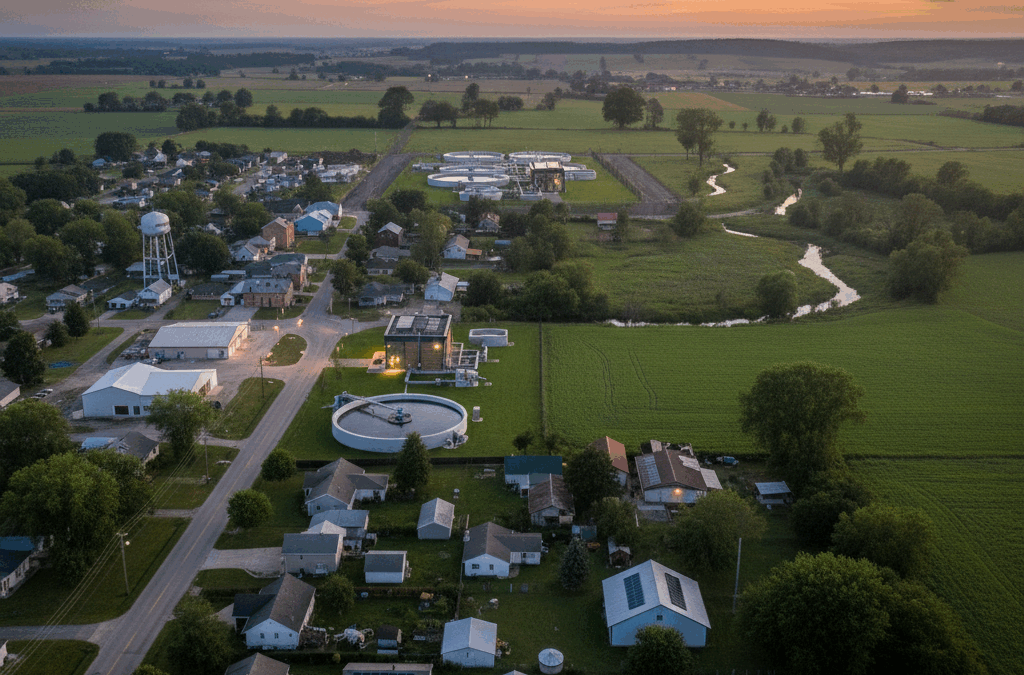
Artistic Impression Of Wastewater Treatment Plant (WWTP)
The Switz City Wastewater Treatment Plant (WWTP) is located at 5429 County Road 200 N., Switz City, IN. The National Pollutant Discharge Elimination System Program or NPDES Permit Number is IN0042650, and the Town of Switz City is registered as the Permittee. It is classified as a Class I, minor municipal WWTP, rated at an average daily influent flow of 0.036 MGD, or 36,000 GPD.
As part of the Switz City Total Asset Management Plan (Plan), SDG Engineering had the privilege of evaluating this WWTP as part of that Plan. SDG Engineering (SDG) served as a subconsultant to the Buried Asset Management Institute – International (BAMI-I), which managed and wrote most of the Plan.
The Town of Switz City owns the WWTP; however, operation of the WWTP has been provided for many years under a contract with Bynum Fanyo Utilities (BFU), located at 3499 W. Maple Grove Road, Bloomington, IN.

SDG conducted a reconnaissance of the WWTP on Wednesday, November 13, 2024. A few highlights of the evaluation are provided in this article.
Original Construction
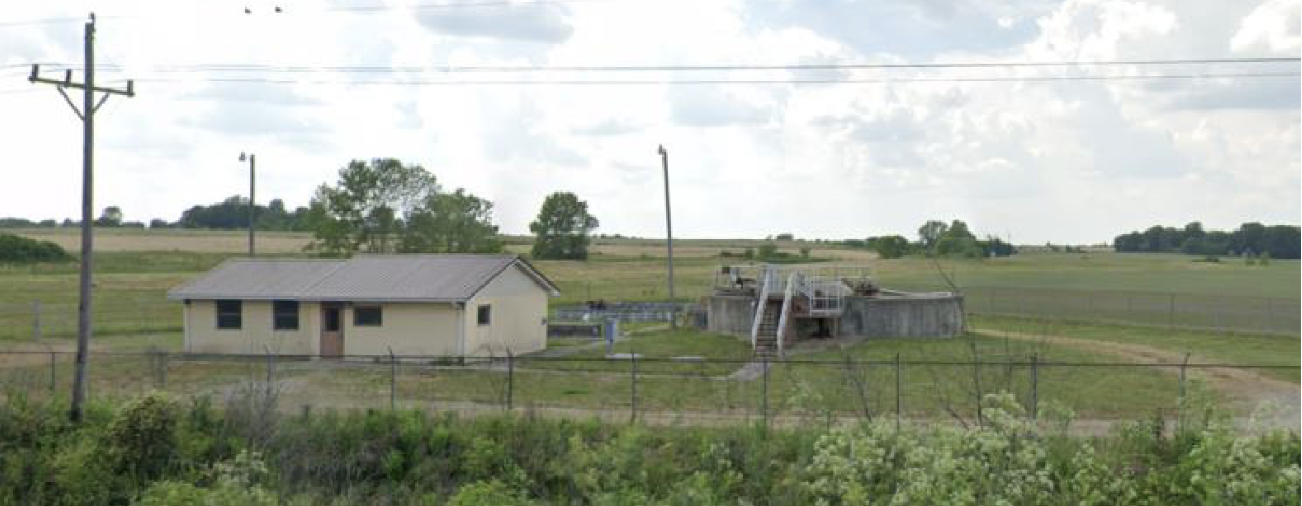
The original WWTP was designed in 1990 by M.D. Wessler & Associates, Inc., Consulting Engineers, Indianapolis, Indiana. It was constructed between 1990 and 1991. The WWTP was constructed under EPA Project Number C180450 02. Based on this EPA Project number, the EPA indicates that a construction grant of $888,977 was provided for this WWTP, which is equivalent to approximately $2 million in current dollars.
A point of interest
SDG conducted a cost estimate to replace this WWTP in fourth-quarter 2024 dollars. The result of this effort revealed that the total replacement of this WWTP, in rough order of magnitude dollars, would be around $1.9 million. This is equivalent to the EPA grant, adjusted to the current value of money as noted above. The methodology for this is described below.
The methodology used to determine its value was based on examining the cost of replacing the WWTP with a new one on the same piece of property as the existing one, which would perform the same function as the existing WWTP. SDG discussed replacement costs with various contractors experienced in WWTP construction, specifically in terms of the unit cost in dollars per gallon. The “gallon” referred to here is the average daily design flow (ADF) for the WWTP. The “grossed-up” unit price values were calculated by aggregating the construction costs for various WWTPs, whether new, a major expansion, or a rehabilitation project, and then dividing that total by the design ADF for those plants. With this knowledge, one can understand the context of these values; they are general because they do not take into account the specifics of a particular project for which they are being applied. Thus, they are to be considered something akin to a Rough Order of Magnitude or ROM cost range. When estimating the ROM cost for a replacement WWTP, one key consideration is the phenomenon of economies of scale. In the construction industry, certain fixed overhead costs must be taken into consideration. As the project grows in size, the per-unit cost of construction tends to decrease because these fixed costs are spread over a larger number of units, such as excavation, concrete, reinforcing steel, square footage, amount of equipment and fixtures, and other factors. For this reason, the unit cost of a small WWTP would be higher than that of a large WWTP due to the phenomenon of economies of scale. The unit cost in terms of dollars per gallon utilized for the Switz City WWTP is on the higher end because it is a small WWTP. The estimated unit cost is presented in a range of $30 to $35 per gallon. It is essential to note that the Rated Design Capacity of the Switz City WWTP, or ADF, is 36,000 gallons per day. It is unlikely that additional capacity will be necessary in the near future. It is with these provisos that replacement values are presented in the Table that follows.
Table: Unit Cost for WWTP Replacement
The costs in the above Table represent construction costs only.
A Total Project Budget is a dollar figure that represents all the possible costs involved in a particular endeavor. The elected leaders of a municipality need to know the total expected costs because they must legally authorize the expenditure of the funds to engage in any significant project. It would be unfortunate for them to authorize a project to proceed and later discover that it costs significantly more than originally anticipated. This is why it is important to attempt to capture all the anticipated costs of a potential project. Some jurisdictions require the adoption of an official Resolution for this purpose, such as a Project Budget Ordinance. Its function is to allocate town funds for a specific project officially. A Total Project Budget is usually the basis for the costs presented in the Project Budget Ordinance.
To determine a Total Project Budget for a replacement WWTP, which would be a major undertaking for the Town of Switz City, other factors must be taken into consideration. For example, a ten percent construction contingency would be appropriate. Further, there are many non-construction related costs, otherwise known as “soft costs,” associated with a new WWTP, including but not limited to:
- Grantsmanship (that which is necessary to secure funding for the project)
- Preliminary Engineering Report (usually required by EPA or a state agency if Federal or State funds are involved)
- Environmental Issues and Permitting (Federal, State, and Local regulatory compliance)
- Engineering Design
- Preparation of Construction Documents (“Plans and Specifications”)
- Advertisement for Construction Bids and Recommendation of Award of Contract (“Bidding”)
- Contract Administration and Construction Observation (CA/CO or Construction Phase Services)
- Start-up services
- Legal Services (If any)
- Final Certification of Construction Compliance by the Consulting Engineer and submission thereof to the regulatory authority
Soft costs are highly variable for each project and are difficult to estimate during the very early planning stages. A typical placeholder number used to budget for these potential soft costs is around 35 to 40% of the construction cost. Therefore, adding the 10% construction contingency and 40% of soft cost expenses results in a factor of 1.5 times the estimated construction costs. Taking the higher unit cost value discussed earlier of $35 per GPD, the replacement cost for a WWTP of this size would be $1,260,000. Therefore, the Total Project Budget for a new replacement plant located on the same piece of property as the existing one would look something like this: $1,260,000 X 1.5 = $1,890,000. In summary, it is suggested that the value of this significant town asset for the second quarter of 2025 should be approximately $1.9 million.
Process
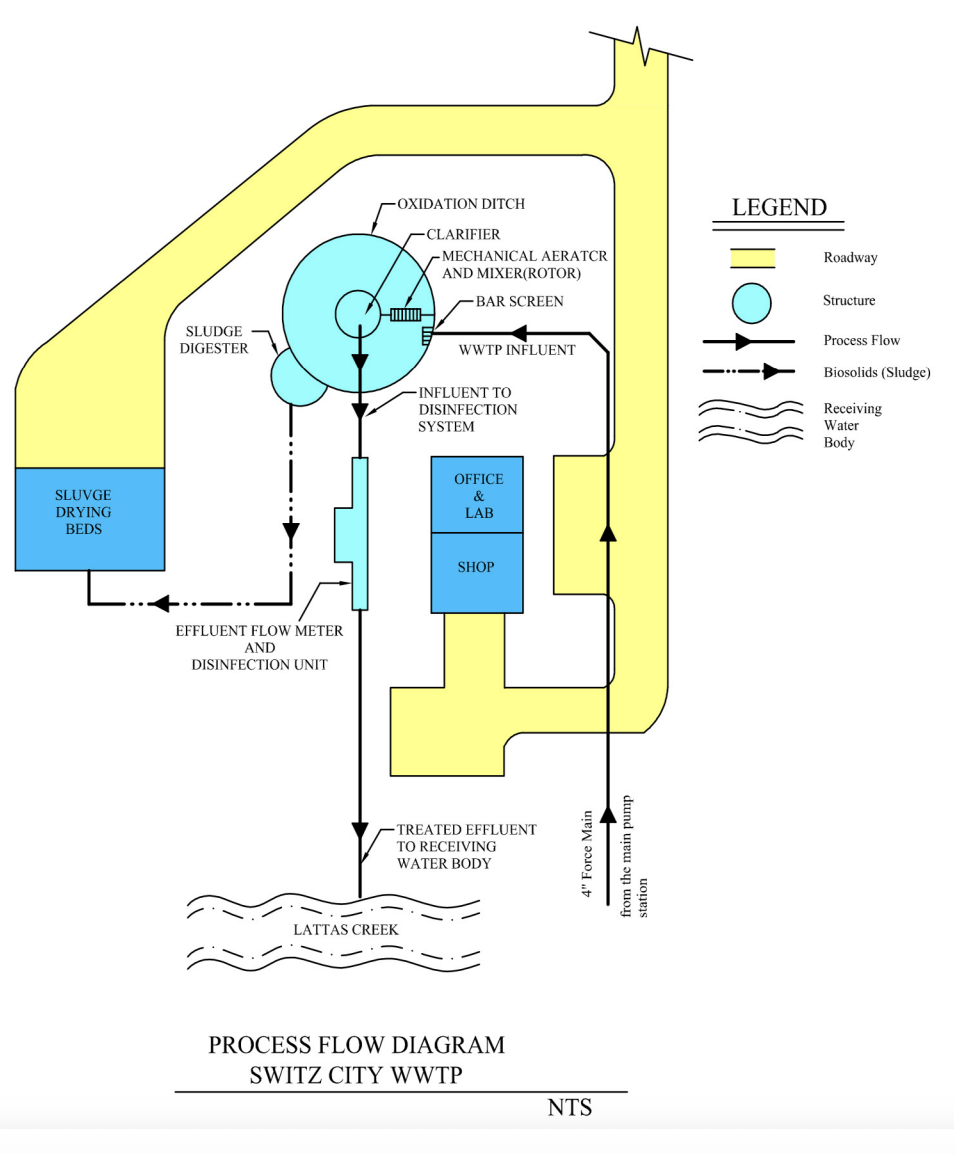
The following figure shows the process flow diagram for this WWTP. It is a biological treatment plant based on the extended air activated sludge treatment process utilizing an oxidation ditch. The treated effluent is discharged to Lattas Creek.
Effluent Limits
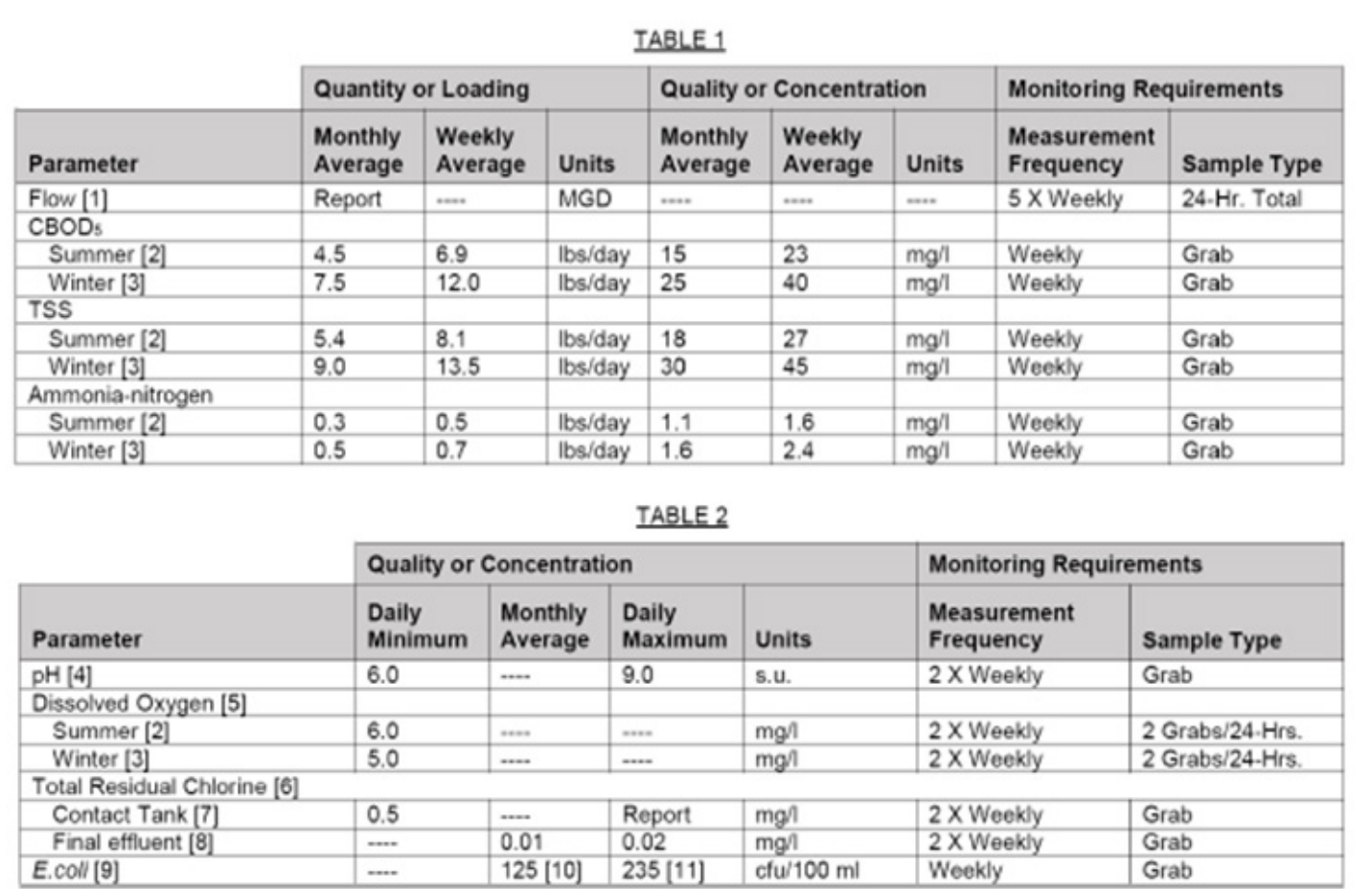
The NPDES permit effluent limits are presented in Tables 1 and 2 below.
The WWTP generally meets all of the NPDES permit effluent limits.
A summary of the findings
The evaluation found that the replacement value of the WWTP is about $1.9 million. It is performing well, generally speaking. However, there is an issue with excessive rain-dependent infiltration and inflow (RDII) that requires attention. The evaluation recommended that the town consider the possibility of regionalization with a nearby municipality, with Bloomfield or Linton being the two possible options. A long-term Capital Improvement Plan (CIP) provided several recommendations totaling $1.5 million worth of repairs, rehabilitation, and replacements.
Author: Kurt Wright

Owner/President of SDG Engineering, Inc. (since 2002), with 36 years of experience in municipal water and wastewater engineering, financing, and asset management, including authorship of the Spindale, NC AMP and active contributions to BAMI-I and CTAM programs.