
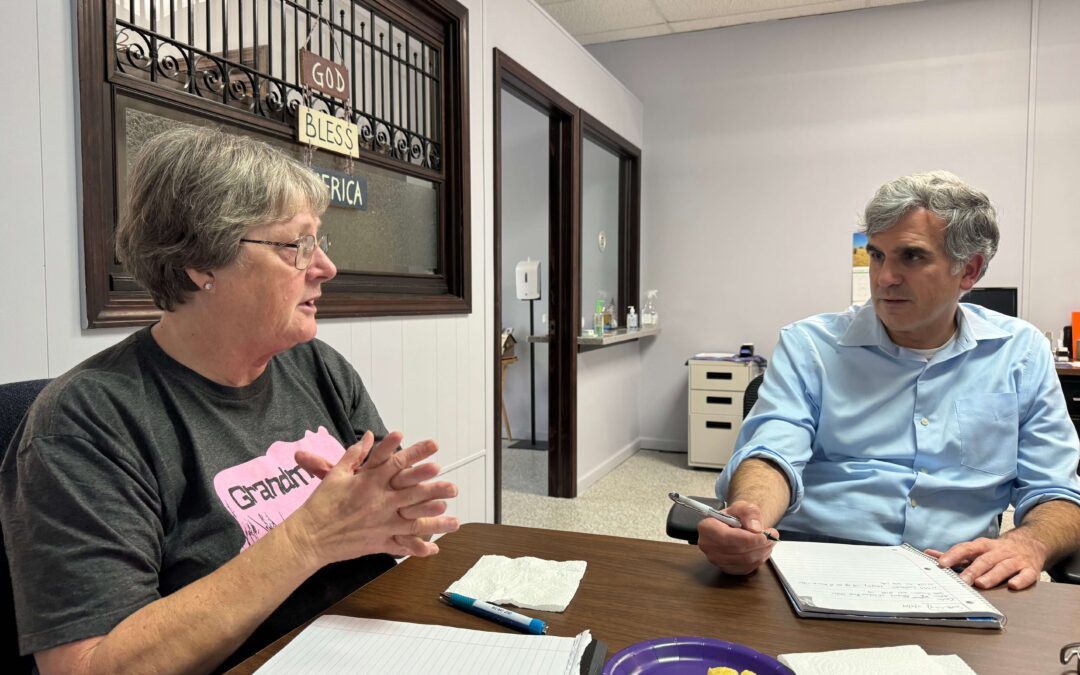
Asset management plans identify capital projects that must be completed so that the utility can continue to provide safe and reliable service, and those capital projects require money. In conjunction with the asset management plan for Switz City, team partner Water Finance Assistance conducted a rate study to determine what rates Switz City needed to charge in order to cover rising operating costs and the costs of implementing the asset management plan. This analysis also gave Switz City an opportunity to think about how it wished to structure its rates.
The purpose of a rate study is to determine if the utility’s current rates will generate sufficient revenue to cover future expected expenses. The rate analysis predicts the future expected operating costs by looking at trends in expenses, as well as any expected debt service payments, capital outlays, and contributions to reserve funds. Taken together, these represent the annual financial target for the utility. The analysis then anticipates future revenues by projecting the number of customers, usage, and bill payment rate and applying the current rate structure. If projected revenues meet or exceed the financial target, the utility can retain the current rates. If not, the rates should change.
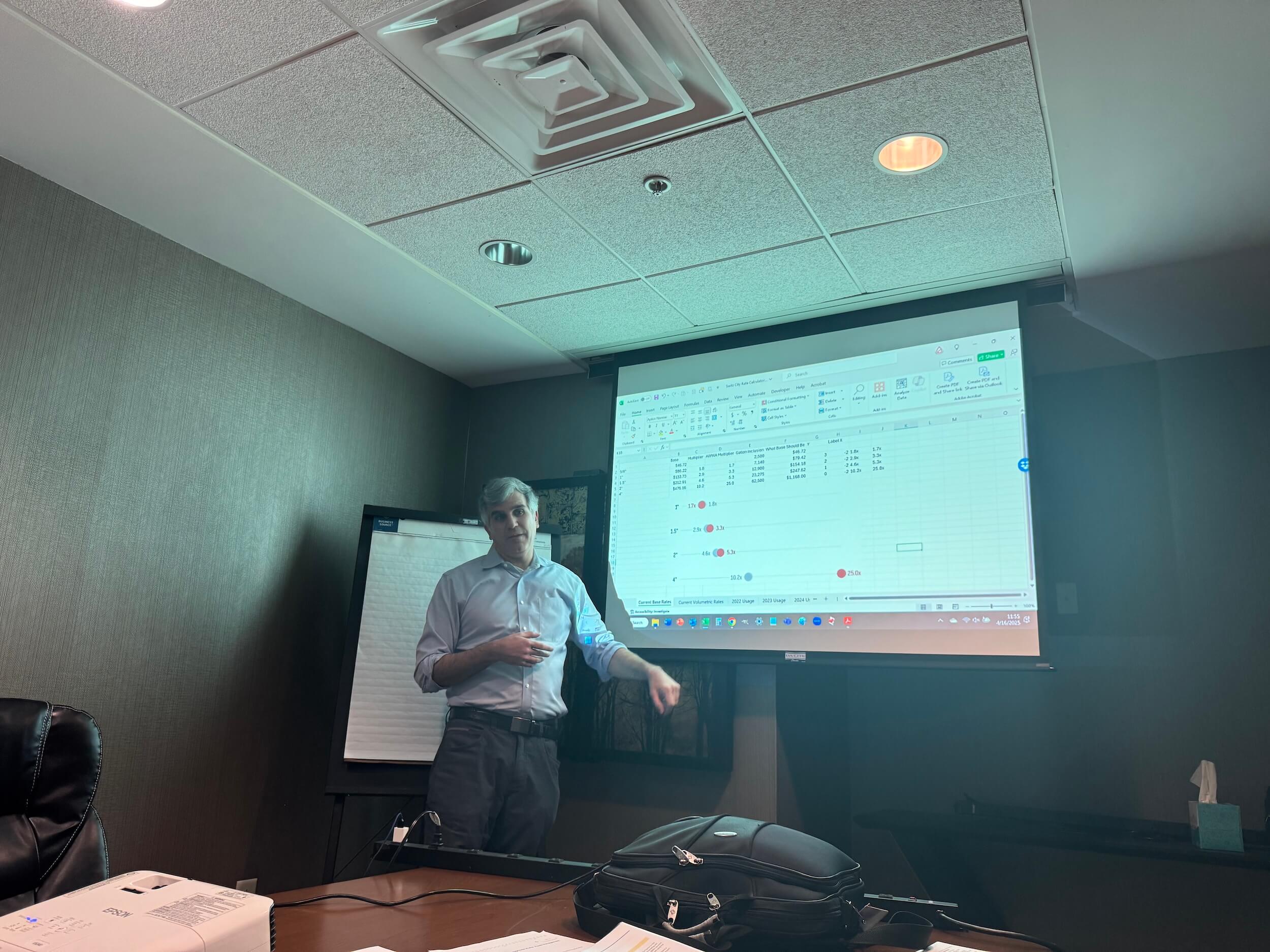
The financial target calculation tells a utility how much money they will need for the coming year but not how to generate that total. The utility could make small adjustments to its current rate structure to generate the extra money, but an asset management plan presents an opportunity for utilities to step back and ask if their current approach to rates makes sense.
The overall goal of any rate structure is to generate sufficient revenue for the utility, but that is not the only priority in rate setting. Utilities, for example, may wish to have stable revenue each month since most of the cost of running utilities do not depend on the volume of water or wastewater treated. Utilities may wish to have rates that are affordable for their least fortunate customers. Utilities may wish to encourage customers to conserve water. They may wish to have rates that are simple for customers to understand and easy for the utility staff to administer. Finally, all utilities should strive for rates that are fair to their customers.
The analysis for Switz City showed that both the drinking water rates and the wastewater rates would need to rise in order to generate sufficient revenue to cover increasing operational costs and substantial debt service related to several high-priority capital projects. The question became how best to structure the rates to meet the appropriate priorities for Switz City.
The rate study first examined the issue of affordability. Switz City serves many less fortunate customers. A review of census data showed that almost half of all families in Switz City are at or below 200 percent of the federal poverty level and would be considered low-income or near-poverty. The median household income in Switz City is more than $28,000 less than the median household income for Indiana as a whole. Income growth in Switz City over the past 15 years has been slower than state and national figures, and incomes are not keeping up with inflation. The lowest income households are barely covering basic necessities such as housing, food, utilities, and health care. Affordability should be a consideration when Switz City structures and prices its rates.
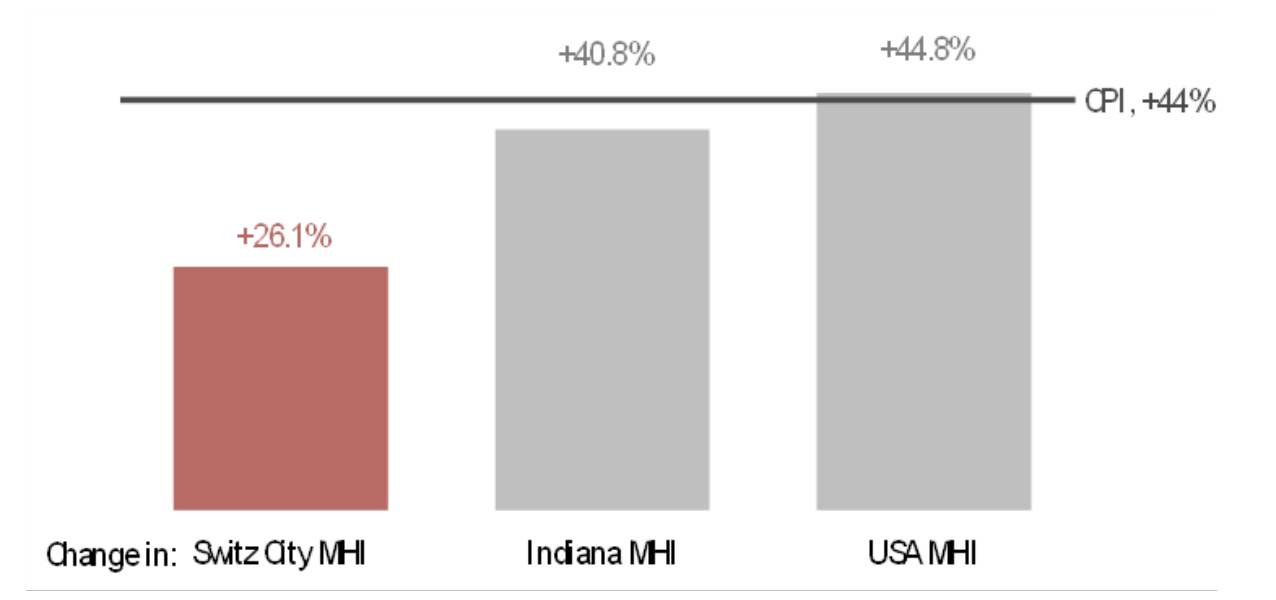
Figure 1: Income growth has been slow in Switz City.
The rate analysis then examined the rate structure itself. Switz City currently has different rate structures for water and for wastewater. Wastewater customers have a monthly minimum charge and then pay a single rate per 1,000 gallons of wastewater generated. This is a straightforward approach to billing that customers can easily understand. Water customers have a different and more complex rate structure. Water rates also have a monthly minimum charge but are then structured as decreasing block, where the price per 1,000 gallons of water used goes down as usage goes up, and there are six blocks.
This type of rate structure can be appropriate in communities with many large users, but Switz City is a largely residential community, and most of its non-residential customers do not use a lot of water each month. Very little usage was in the highest blocks.
The price differential between the five highest blocks is also relatively small. There isn’t much point of having separate blocks if the price differential is so tiny. It only creates work for the utility without actually saving the customer a lot of money.
Utilities with block rate structures should evaluate the effectiveness of block rate structures on an annual basis, and that involves examining the usage of each customer each billing period. Switz City, however, does not have an easy way to export customer-by-customer usage data in a format that allows for easy analysis.
Figure 2: Most revenue comes from the first two blocks.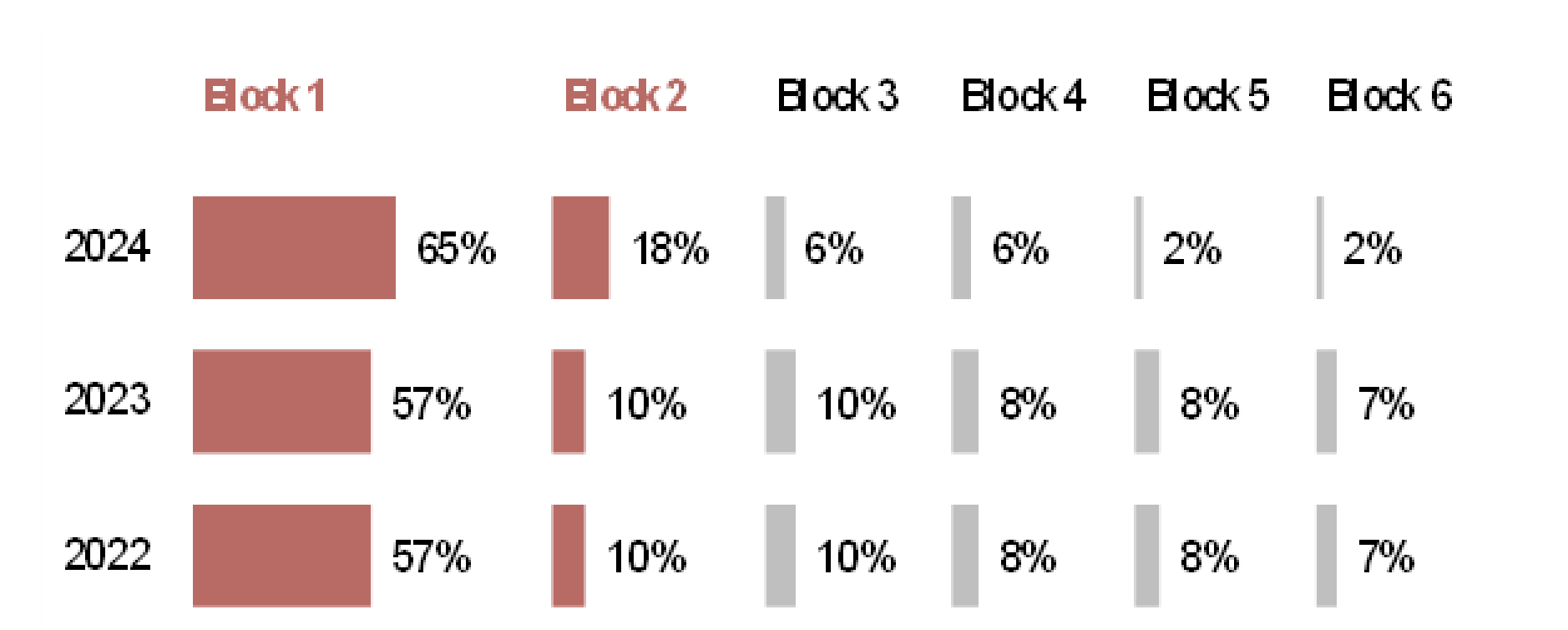
All these factors suggest that Switz City’s water rate structure was unnecessarily complicated. Customers are more likely to accept rates and rate changes when the rate structure is easily understood.
The rate analysis proposed two potential drinking water rate options for Switz City. The first would keep the current structure in place and increase all prices evenly. The second would simplify the rate structure to one that mirrors the wastewater rate structure, with a monthly minimum charge and then a single price per 1,000 gallons at all levels of usage.
Both rate options would generate the same amount of revenue for the utility. Which option, then, is “right”? There is no definite answer to that question. The current rate structure may be complicated, but customers are familiar with it, and since most customer usage was low, their bills only involved the first block or two of the rate structure. On the other hand, lower use customers (who may also be lower income customers) would fare better under a simplified structure because the price per 1,000 gallons at lower usage levels would be lower.
Utilities should not feel that they need to restructure their rates during the asset management process, but it is a good time to ask why the rates are structured the way they are and if that makes sense for the community. If the answer is that the rates are structured that way because “that’s the way they have always been,” it may be a good idea to consider alternatives.
About author: Glenn Bio

Glenn Barnes
Glenn Barnes is the Director of Water Finance Assistance, a training and technical assistance organization dedicated to building the financial and managerial skills of drinking water and wastewater utility employees. He has worked for more than 15 years with utilities of all sizes across the country. Glenn’s work focuses on rate setting, asset management, affordability, increasing bill payments, accessing infrastructure funding, water loss and conservation, and workforce retention. All the work of Water Finance Assistance is rooted in data analysis, allowing utility staff to make informed and objective decisions to improve their sustainability and to serve their communities for years to come. Glenn is based in North Carolina.