Core Curriculum Overview
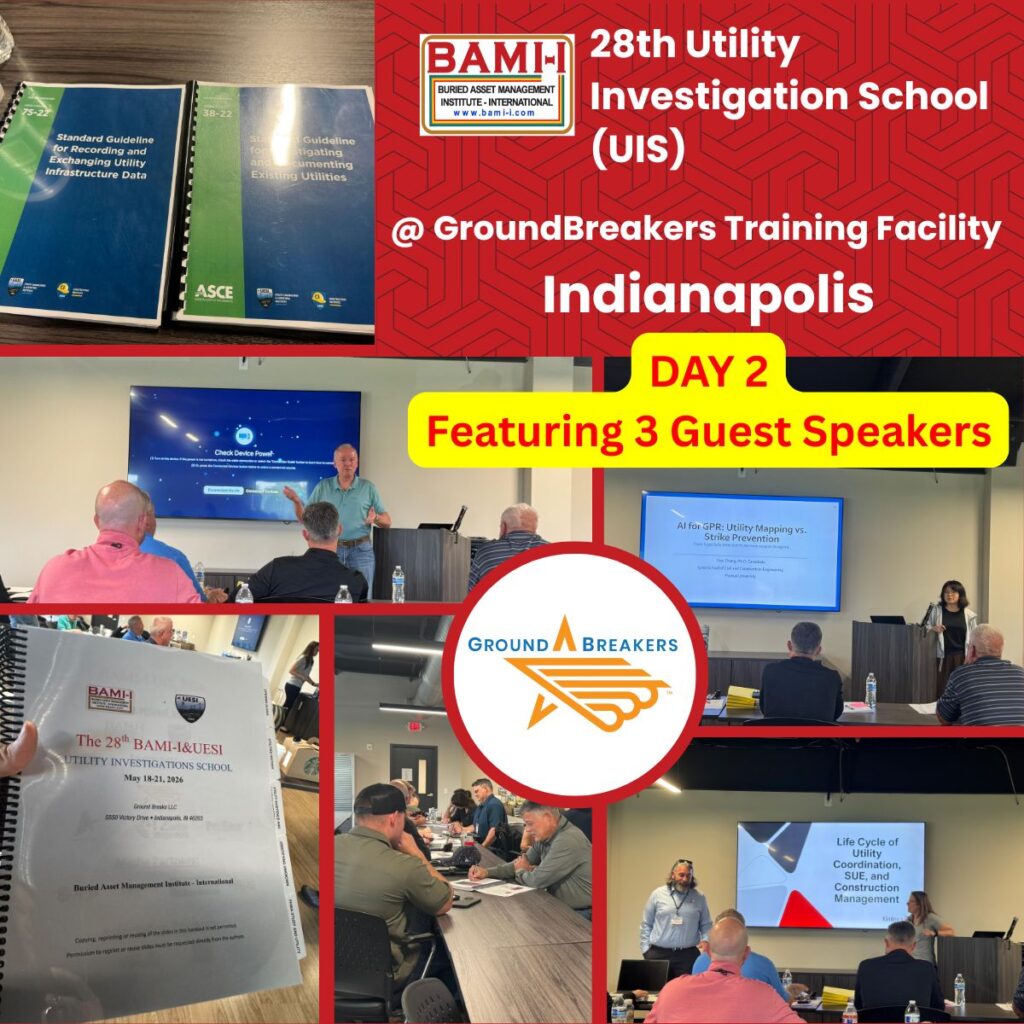
The core of the day focused on ASCE 38-22 Part 2 and an introduction to ASCE 75-22 (the Utility Data Exchange Standard), supplemented by comprehensive afternoon sessions covering:
-
Indiana SUE/UE practice
-
The Six Pillars of Utility Engineering
-
Utility Engineering History
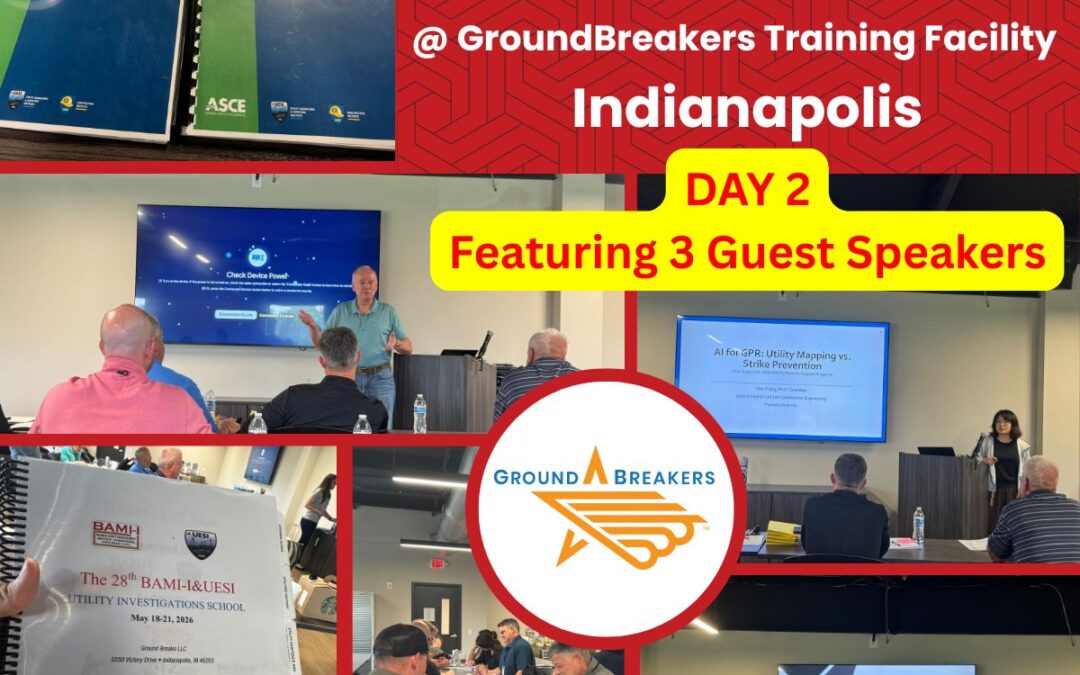
Inside that, we made room for guest contributions from three industry experts bringing critical perspectives that the standards alone cannot cover.
Guest Speaker Highlights
1. AI for Ground Penetrating Radar (GPR)
Yuxi Zhang — Purdue University
a PhD researcher in Prof. Hubo Cai's lab, returned to UIS with a research update. She demonstrated GPR equipment at a Purdue-hosted UIS previously; this time she focused on her current work on AI for GPR: pipe mapping vs. utility strike prevention. Her point:
-
Pipe Mapping vs. Utility Strike Prevention: Her core point emphasized that a hyperbola in a radargram does not prove a utility is there, and a real utility does not always show up as a clean hyperbola.
-
Decision Metrics: Pattern recognition is not interpretation. She explicitly separated utility mapping (where is it, and with what level of confidence) from strike prevention (could digging here hit something) as two entirely different decision problems, each carrying distinct levels of risk tolerance.
-
The AI Gap: General-purpose AI models like ChatGPT deliver fluent but physically incorrect answers. What the industry truly requires is domain-specific agents deeply grounded in GPR physics and locator reasoning.
2. The Lifecycle of SUE & Utility Coordination
Natalie Parks, PE — Kimley-Horn
A longtime presenter on this topic at the UIS and a longtime colleague of Jim Anspach and Dr. Tom Iseley, walked us through the lifecycle of SUE, utility coordination, and construction management.
-
The Problem with Legacy Data: 811 marks were originally built for damage prevention, not proactive design. As a result, the industry has spent decades making critical design decisions based on five-year-old, completely unverifiable data.
-
Best Practices in Action: She walked through what high-tier coordination looks like in practice: executing SUE starting at 10% design, ensuring ASCE 38 deliverables are formally signed and sealed, deploying detailed conflict matrices, and accurately placing test holes based purely on evidence.
-
Construction Integration: She illustrated how Colorado is successfully carrying that vital data straight into construction utilizing ASCE 75 and PointMan for precise, georeferenced as-builts.
-
Key Takeaway: > "Utility coordination is a relationship business as much as a technical one."
3. Contractor & Industry-Policy Perspectives
Kurt Youngs — President, NUCA; Chair, CGA
Kurt gave the contractor and industry-policy view from 50 years in the field.
-
Legislative & Ticket Dynamics: Highlighted four pieces of 811 legislation moving through the Indiana statehouse. Notably, 60–70% of Indiana ticket volume originates directly from utilities and their own contractors, rather than residents.
-
The IIJA Funding Window: Only 28% of IIJA money has been spent so far; the remaining balance must land by 2028.
-
Data Quality Progress: CGA's DIRT report historically captured roughly 38% accurate information from the largest locating firms; that figure is now closer to 78%. NUCA has also built an expanded DIRT page on top of CGA's, giving contractors their own data trail.
-
Standardization Success: CGA has officially accepted ASCE 75 as the benchmark data standard for the MUDDY model.
Standards in the room, practice in the field. That's what UIS is for.