By Mark G. Wade, P.E.
The American Society of Civil Engineers (ASCE) published its first manual of practice in 1992 to help the utility industry improve their manhole inventory. Since then, MOP 92 has been updated twice. The most current update (released in December 2022) is particularly helpful to anyone engaged in manhole inspection, design, rehabilitation, renewal, and asset management.
This article provides an overview of the updates included in this 3rd edition, focusing specifically on the critical technologies and methods used in manhole rehabilitation today.
The Evolution of MOP 92
The idea for MOP 92 began in 1991 during the annual ASCE Pipeline Infrastructure (PINS) meeting. There was broad consensus that a manual dedicated to the inspection, rehabilitation, and management of manhole structures was needed. Through a partnership with the ASCE Committee on Manhole Rehabilitation and NASSCO, the first edition was published in 1997.
While previous editions addressed inspection, scoring, and prioritization, the 3rd Edition significantly expands on Chapter 5: Manhole Rehabilitation Methods, providing a robust look at the technologies available to both private and public utilities.
Exploring Chapter 5: Manhole Rehabilitation Methods
Once inspection data is gathered, it must be reviewed to prioritize repairs and select the right methodology. Material and technology choices depend on the specific project goals: correcting structural deficiencies, addressing maintenance requirements, eliminating Inflow & Infiltration (I&I), or preventing future corrosion.
Here is a breakdown of the primary rehabilitation methods covered in the manual:
1. Manhole Covers and Frames
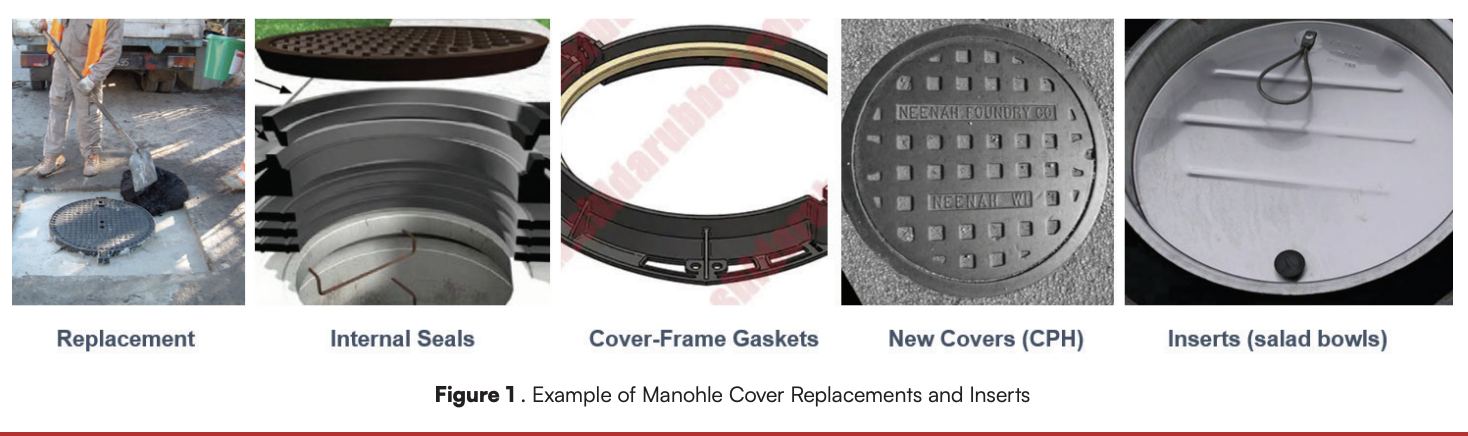
Defects in covers, frames, and chimneys present multiple opportunities for surface water (inflow) to enter the manhole. This accounts for a significant amount of leakage, contributing to sanitary sewer overflows.
- Solutions: Leaking covers can be sealed by plugging vent holes, replacing them with watertight covers, installing bitumastic sealants, or replacing rubber gaskets. Manhole dishes (inserts) under the cover are also common to capture residual water in flood-prone areas.
2. Chimney and Wall Joint Seals
Ground movement, thermal expansion, frost heave, and traffic loading can break the seal between the frame and chimney.
- Internal & External Seals: The frame-chimney joint area can be sealed internally without excavation if alignment permits. Methods include mechanical seals, flexible epoxy/urethane sealants, mastic and rubber adhesive laminates, and cured-in-place liners.
- Wall Joints: Worn or improperly installed joint gaskets can allow infiltration. These are often sealed using mechanical joint seals or flexible applied sealants (after active leaks have been stopped).
3. Injection Grouting
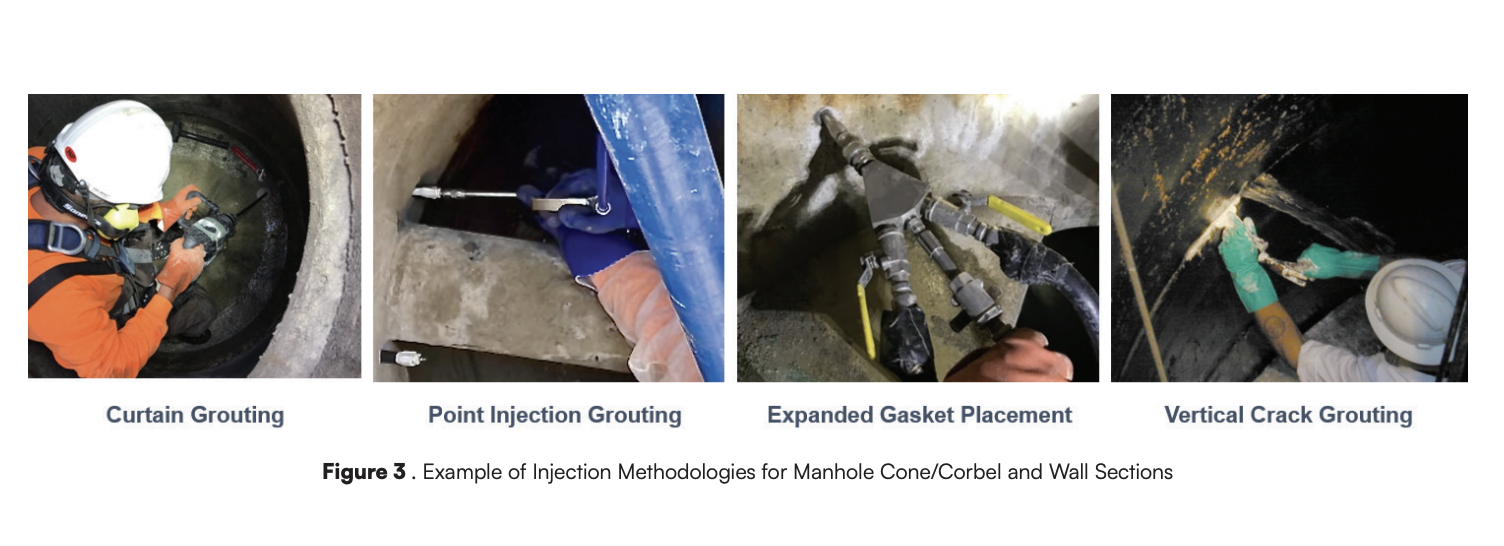
Injection grouting is typically used for infiltration control and void stabilization. It is also used in conjunction with coatings to stop infiltration prior to liner installation. Success depends on soil conditions, moisture, injection patterns, and the crew’s experience.
Types of Grouts:
- Acrylic Gels: Often specified for curtain grouting to create an impermeable gel/soil matrix outside the structure.
- Urethane Gels: A prepolymer that activates with water, offering excellent permeation properties for water barriers and soil stabilization.
- Hydrophobic Urethane Foams: Require little water to activate, withstand wet/dry cycles, and have high expansion rates (ideal for void filling).
- Hydrophilic Urethane Foams: Moisture-activated and well-suited to seal cracks, joints, and pipe penetrations.
Common Grouting Techniques:
- Curtain Grouting: Encapsulates the structure by drilling through the walls in a serpentine pattern and pumping grout to the outside.
- Expanded Gasket Placement (EGP): Inserts a resin-soaked backer rod into a joint, which expands upon reacting with groundwater to create a watertight gasket.
- Horizontal Joint / Vertical Crack Injection: Targets specific seams or defects by injecting flexible grouts directly into the compromised area.
4. Coatings and Liners
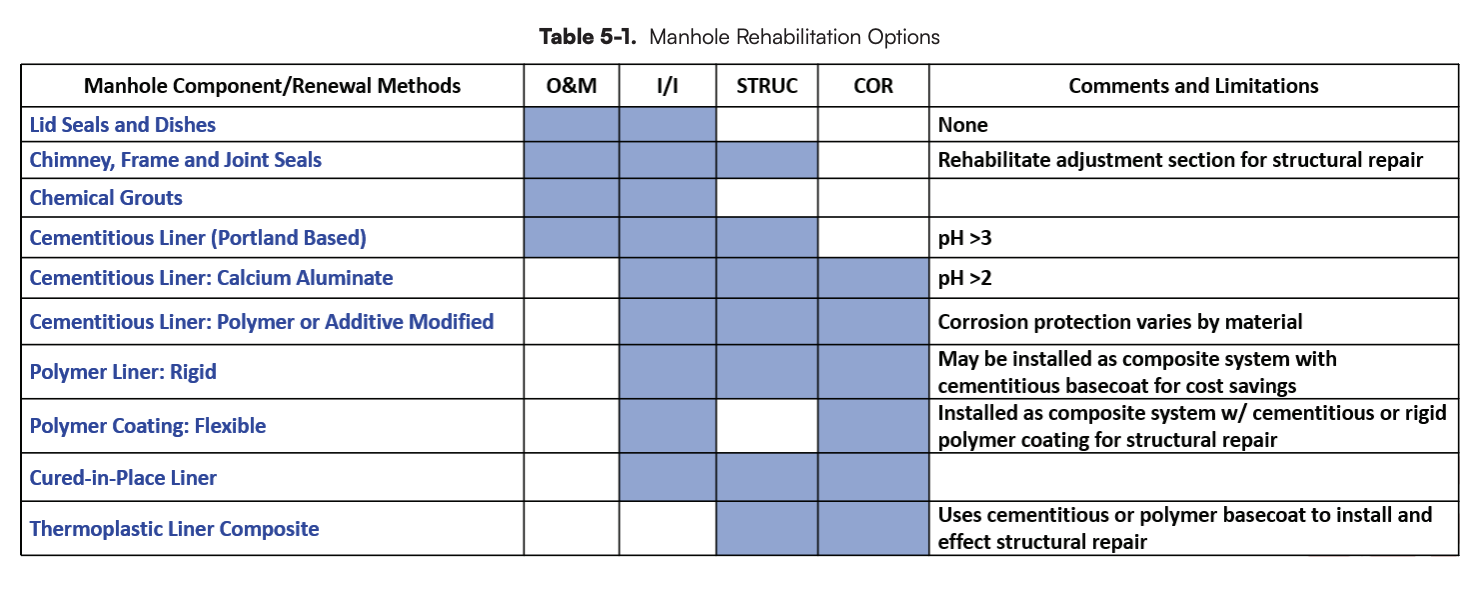
Coatings provide a barrier against surface/groundwater and future corrosion, while liners are used to restore surfaces and renew structural integrity. Proper surface preparation—including cleaning, decontaminating, and profiling—is critical for these applications.
- Cementitious Liners: Provide effective solutions for infiltration, structural rehabilitation, and corrosion protection (often via specialty cements or antimicrobial additives). They can be troweled, sprayed, or spin-cast.
- Formed-in-Place (FIP) Concrete: Provides a new concrete interior wall conforming to the existing shape. It fills all voids, creating a completely independent new structure without the need for excavation.
- Polymer Coatings and Liners: Epoxies, polyurethanes, and polyureas offer structural enhancement and excellent corrosion resistance. Epoxies are highly moisture-tolerant, while polyureas offer maximum flexibility but require dry substrates.
- Cured-in-Place Manhole (CIPM): Consists of a pre-measured, resin-saturated “bag” installed into the manhole and expanded using steam pressure. It is highly effective for structural rehabilitation where replacement is impossible.
- Composite Systems: Combines multiple materials, such as using a cementitious product for rebuilding the structure, followed by a polymer coating for corrosion protection.
Asset Management & The Decision Matrix
Decision-making becomes easier once the specific needs of the asset are clearly identified. Because there are so many rehabilitation options, specifiers can custom-design each project for immediate and long-term needs.
MOP 92 features a detailed Manhole Rehabilitation Decision Matrix that helps utilities categorize defects from “Low” (isolated leaks) to “Severe” (missing walls, exposed rebar) and prescribes the appropriate corrective actions—ranging from simple hydraulic cements to full-depth rehabilitation or complete structural replacement.
To dive deeper into these technologies and view the complete Decision Matrix, you can purchase the full ASCE MOP 92 (3rd Edition) from the ASCE online bookstore.
*** About the Author: Mark G. Wade, P.E. is the President of BlueWater Solutions Group, Inc. With over 46 years of experience in consulting engineering, he has managed more than 1,100 projects related to buried pipeline systems worldwide and is a leading voice in underground infrastructure asset management.