
By Aaron Homing Ni
1. Introduction
In the field of pipe rehabilitation, Flexible Fabric Reinforced Pipe (FFRP) liners have emerged as a popular solution for restoring the structural integrity and hydraulic performance of aging pipelines. However, determining the appropriate outer diameter (OD) of the FFRP liner is a critical consideration that requires careful attention. This article delves into the significant of selecting the appropriate OD for FFRP liners and the implications it has on pipe rehabilitation projects.
2. Standardization Challenges
Several standards, including ISO11298-1 and ISO11298-11, have been established with the objective of standardizing the utilization of Lining with inserted hose techniques. However, these standards exhibit a significant gap when it comes to providing explicit guidance to pipeline owners on designing the OD of FFRP liners. This lack of clarity presents challenges for the industry currently facing, as it strives to undertake pipe rehabilitation projects with the highest level of precision and accuracy.
To address the lack of OD design guidelines, companies like ASOE Hose Manufacturing Inc. have stepped up to offer customized solutions. ASOE demonstrates its ability to design and manufacture FFRP liners with different ODs to meet the diverse needs of different pipe sizes to be rehabilitated so as to enhance flexibility in their selection. For instance, when rehabilitating a DN500 water pipes, ASOE offers a variety of OD options, such as 454mm, 470mm, 475mm, 480mm, 485mm, and 490mm, to owners who are looking to rehabilitate DN500 water pipes.
3. The Importance of Close Fit
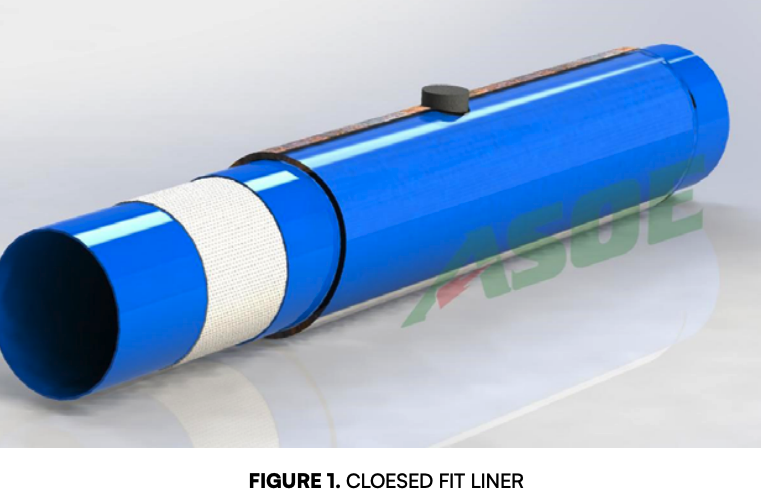
The primary objective when selecting an FFRP liner OD is to ensure a close fit between the liner and the host pipe under operating pressure. Achieving a snug fit is crucial as it eliminates the presence of an annual space or gap between the liner and the host pipe to prevent long term effect to the liner, Eg:
- The accumulation of corrosion within the pipe, root growth and subsequent leaks can result in soil infiltration, potentially leading to a reduction in the cross-section of the pipe and compromising its long-bearing capacity.
- Deformations of the host pipe diameter
- Crack formation
- Groundwater contain impurities, contaminants and microorganisms. These impurities can include chemicals, heavy metals, bacteria, viruses and other pathogens. When groundwater infiltrates pipes, it can introduce these impurities into the system.
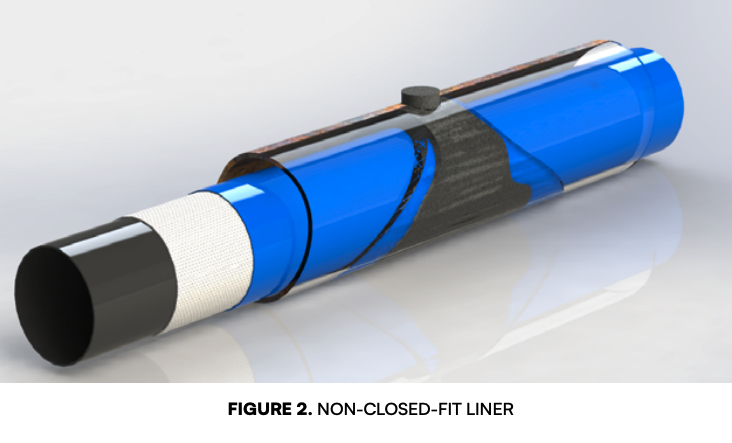
Firstly, if smaller OD liners, such as 450mm, 454mm, or 460mm, are installed, an annual space is created. This gap becomes an entry point for water, earth, and sand to infiltrate the host pipe through leaking holes. In cases where the water supply is temporarily terminated, vacuum pressure can develop within the pipeline. If the vacuum pressure reaches a significant level, the FFRP liner may collapse temporarily, leading to further sand and earth ingress.
Subsequent resumption of water supply causes the water within the annual space to be squeezed out, but the sand and earth remain, accumulating over time. Although the liner is expected to be subject to the groundwater pressure practically in all design cases, other loads may be transferred on the liner in some way during the service life of the liner if the host pipe deteriorates further or the surrounding soil weakens.
These accumulations can gradually press against the liner, potentially choking its functionality and necessitating pipe rehabilitation once again. Furthermore, a close fit between the FFRP liner and the host pipe minimizes the reduction in the liner’s inner diameter, ensuring maximum water flow and hydraulic efficiency.
4. Requirements for OD Selection
Based on the aforementioned considerations, two key requirements emerge for selecting the OD of FFRP liners in pipe rehabilitation projects.
Requirement One: Close Fit under Operating Pressure
Owners must choose FFRP liners that can closely fit the inner wall of the host pipe when subjected to operating pressure. If owners install FFRP liners with ODs of 450mm, 454mm, or 460mm, it will result in the formation of an annual space. This space provides an entry point for water, earth, and sand to infiltrate the host pipes through leaking holes and fill the gap. In the event of temporary water supply termination, vacuum pressure may occur within the pipeline. When the vacuum pressure reaches a certain level, the FFRP liner could temporarily collapse, allowing more sand and earth to enter the annual space.
Upon resumption of water supply, the water within the annual space can be expelled, but the sand and earth will remain trapped. If water supply disruptions occur repeatedly, the accumulation of sand and earth will progressively increase, exerting infinite pressure on the liner (as shown in the provided image). This accumulation can cause the FFRP liner to become choked, necessitating pipe rehabilitation.
Additionally, when the FFRP liner closely fits the inner wall of the host pipes, it minimizes the reduction in the liner’s inner diameter (ID), ensuring maximum water flow. This close fit is crucial for maintaining optimal hydraulic performance. The range of OD options provided by companies like ASOE allows owner to make an informed decision that caters to the specific requirements of their pipe rehabilitation projects.
Requirement Two: Avoiding OD Exceeding ID
It is essential to ensure that the OD of the FFRP liner does not exceed the ID of the host pipe. If the OD is larger than the ID, the liner will not be able to fully expand within the pipe, leading to a decrease in water flow capacity. This limitation emphasizes the significance of meticulous OD selection to preserve the hydraulic performance of the rehabilitated pipeline.
Requirement Three: Grouting or patch rehabilitation is necessary to close the leaking holes/cracks if annular space between host pipe and liner exist
Without closed-fit, all leaking holes/cracks should be closed by grouting or other patch rehabilitation techniques. Closing leaking holes/cracks is to stop soil infiltration. In fact, in many scenarios it is impossible to close the leaking holes or cracks of the host pipes undr ground or rivers. For example, if water pipes under river contains leaking holes, it is difficult or impossible to stop water and mud infiltration by grouting or patch rehabilitation techniques. Closed-fit lining is preferred due to its superior structural integrity, leak prevention, improved flow capacity, reduce contamination risk and long term performance benefits.
5. Conclusion
Determining the suitable OD for FFRP liners in pipe rehabilitation is a crucial factor that profoundly impacts the project’s success and durability. Although existing standards may not provide clear directives on this matter, companies like ASOE Hose Manufacturing Inc. specialize in customized solutions to cater to owners’ precise needs. By placing emphasis on achieving a tight fit between the liner and the host pipe, it can effectively mitigate the risks associated with the formation of an annual space and ensure the optimal hydraulic performance of the rehabilitated pipeline.
Aaron Homing Ni is the president of Sales at Asoe Hose Manufacturing Inc.