
Subsurface Utility Engineering (SUE) and Utility Coordination (UC): The Cornerstone of Quality Control
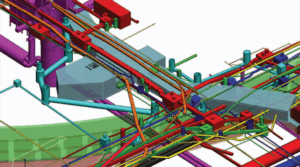
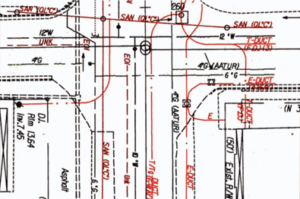
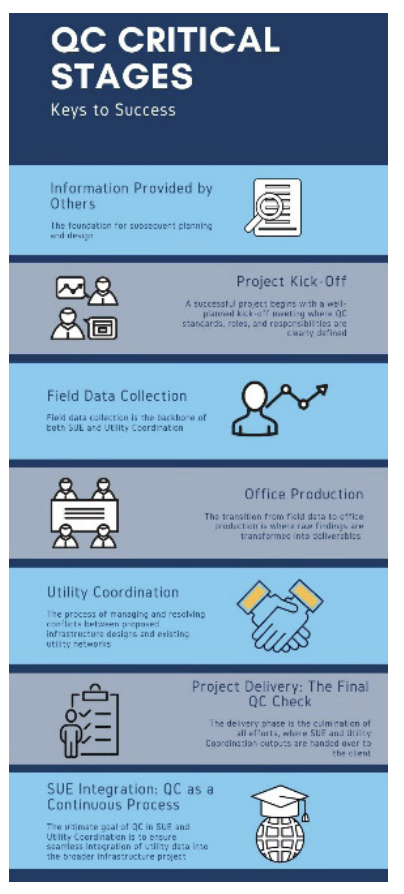
Subsurface Utility Engineering (SUE) and Utility Coordination (UC) are essential for modern infrastructure development, ensuring safe, efficient, and cost-effective utility management. These two disciplines work together to prevent conflicts, reduce risks, and streamline project delivery. At the heart of their success is Quality Control (QC)—a structured process that ensures accuracy, consistency, and reliability throughout every project phase. Without robust QC protocols, projects are vulnerable to safety hazards, costly rework, and delays. This article explores the importance of QC across seven critical stages:
- QC of Information Provided by Others
- Project Kick-off
- Field Data Collection
- Office Production
- Utility Coordination
- Project Delivery
- Overall SUE Integration

1. QC of Information Provided by Others

Both SUE and Utility Coordination rely heavily on accurate, external information, such as utility owner records, GIS data, and as-built drawings. This information forms the foundation for subsequent planning and design. However, a common challenge arises when clients request a high-quality deliverable based on lower-quality data from another consultant. This highlights the critical importance of reliability and accountability in data provided by others.
Incorporating ASCE 38-22 Standards
According to ASCE 38-22 (Section C4.1.6: Quality Assurance and Third Parties), a Quality Assurance and Control Plan is essential when third-party contributors are involved. This plan helps manage risks effectively, as these contributors may not have a direct contractual relationship with the SUE firm.
Key points from ASCE 38-22 to consider:
- Risk Allocation: A plan should clearly outline how risks will be apportioned for data or actions outside the SUE firm’s direct control, especially when assigning a Utility Quality Level or producing deliverables based on third-party input.
- Accountability: Establishing a plan ensures all parties are held accountable for the quality and reliability of their contributions, reducing the likelihood of disputes and providing clarity.
- Dependable Deliverables: By implementing such a plan, the SUE team ensures that deliverables meet the project’s specified standards, despite the involvement of third parties.
QC Practices for Incoming Data
- Verification: External data must be cross-checked with site inspections and reliable sources to identify inaccuracies.
- Risk Mitigation: Robust QC ensures potential discrepancies are flagged early, minimizing downstream impacts and protecting the project owner’s interests.
- Standardization: Adhering to ASCE 38-22 guidelines allows SUE firms to maintain consistent standards across all incoming data.
2. Project Kick-Off: Establishing an All-In Approach for Success
A successful project begins with a well-planned kick-off meeting that embodies an “all-in” approach, where the professional in charge or engineer of record establishes direct responsible charge for the project.
- Shared Expectations: Align all stakeholders on timelines, deliverables, and QC processes.
- Utility Coordination Integration: Use the kick-off to gather input from utility owners and stakeholders.
- Scope Confirmation: Validate the project scope, including SUE and coordination activities, to ensure alignment with client requirements.
By emphasizing leadership and setting clear QC protocols, the kick-off meeting establishes a foundation for collaboration, efficiency, and precision.
3. Field Data Collection: A Collaborative Foundation for Success
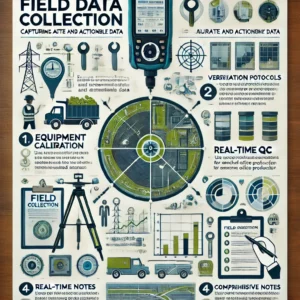
Field data collection is the backbone of SUE and Utility Coordination, requiring an “all-in” approach led by the professional. The accuracy of this data is critical to utility mapping, coordination efforts, and overall project outcomes.
- Equipment Calibration: Ensure tools like Ground Penetrating Radar (GPR) and electromagnetic locators are calibrated and functioning properly to collect reliable data.
- Verification Protocols: Implement a two-pass system for data collection and verification to catch errors in the field.
- Real-Time QC: Use advanced technologies to perform real-time quality checks, identifying and resolving inconsistencies on-site.
- Utility Stakeholder Input: Coordinate field efforts with utility owners to validate findings and accurately confirm asset locations.
4. From Field Data to Deliverables (Office Production)
The transition from field data to office production is a critical phase where raw findings are transformed into deliverables like utility maps, CAD drawings, and GIS models. This stage demands a collaborative, all-in approach led by the professional in charge.
- Data Validation: Rigorous cross-checking of field data ensures consistency and accuracy.
- Utility Coordination Support: Deliverables must include accurate utility information to facilitate coordination efforts and resolve conflicts.
- Peer Reviews: Integrate secondary reviews by qualified team members to identify and address potential oversights.
- Client-Focused Outputs: Deliverables must be clear, user-friendly, and tailored to align with the client’s goals.
Through a collaborative effort, QC at this stage ensures deliverables are precise, reliable, and effective.
5. Utility Coordination: Preventing Conflicts and Enhancing Collaboration

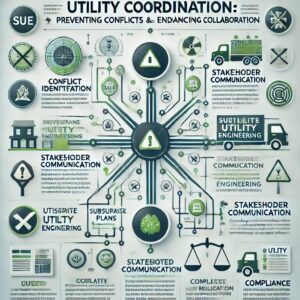
Utility Coordination is the process of managing and resolving conflicts between proposed infrastructure designs and existing utility networks. It is an iterative process that demands rigorous QC.
- Conflict Identification: QC ensures that potential conflicts are identified and accurately documented.
- Stakeholder Communication: Clear, consistent communication with utility owners is essential. QC processes help ensure this communication is timely and accurate.
- Coordination Plans: Develop and QC detailed plans to relocate or protect utilities, ensuring they are feasible and cost-effective.
- Compliance: QC ensures that all coordination activities comply with local regulations and project specifications.
6. Project Delivery: The Final QC Check with an All-In Approach
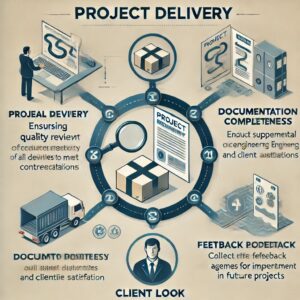
The delivery phase is the culmination of all project efforts, requiring a final QC check to ensure SUE and Utility Coordination outputs are accurate, complete, and aligned with client needs.
- Comprehensive Review: Conduct a thorough review of all deliverables, including maps, reports, and coordination plans, to verify they meet contractual obligations.
- Documentation Completeness: Provide clients with complete and organized documentation, including notes and decision logs, ensuring long-term value.
- Client Presentation: Deliver a clear, concise presentation of the project outputs, addressing client questions and ensuring full understanding.
- Feedback Loop: Gather post-delivery feedback to identify opportunities for improvement.
7. SUE Integration: QC as a Continuous Process
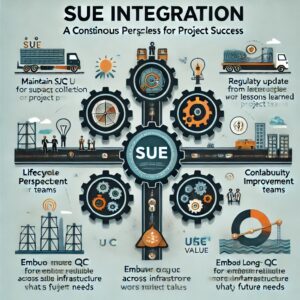
The ultimate goal of QC in SUE and Utility Coordination is the seamless integration of utility data into the broader infrastructure project. This requires viewing QC as an ongoing process rather than a series of isolated checks.
- Lifecycle Perspective: QC must be maintained from initial data gathering to project handoff, ensuring consistency and accuracy at every stage.
- Continuous Improvement: Regularly evaluate and update QC processes to incorporate innovative technologies and lessons learned.
- Collaboration Across Disciplines: QC is most effective when integrated across all project teams, including design, construction, and project management.
Conclusion: QC as the Cornerstone of SUE and Utility Coordination Success
Quality Control is the backbone of effective Subsurface Utility Engineering (SUE) and Utility Coordination (UC). It underpins every stage of a project, from verifying external information to aligning expectations during kick-off, ensuring accuracy in field data collection, transitioning seamlessly through office production, managing utility coordination, and delivering a complete and reliable project outcome.
Through an “all-in” approach led by the professional or engineer of record, QC minimizes uncertainty in the data, ensuring accuracy and consistency throughout the project lifecycle. This collaborative and continuous focus on quality reduces risks, enhances project outcomes, and builds trust with clients and stakeholders. As infrastructure demands grow, the integration of rigorous QC processes will be essential for delivering projects that are efficient, cost-effective, and reliable.

Author
Joseph Porter, PMP
Quality Manager, Utilities
Lamb-Star Engineering